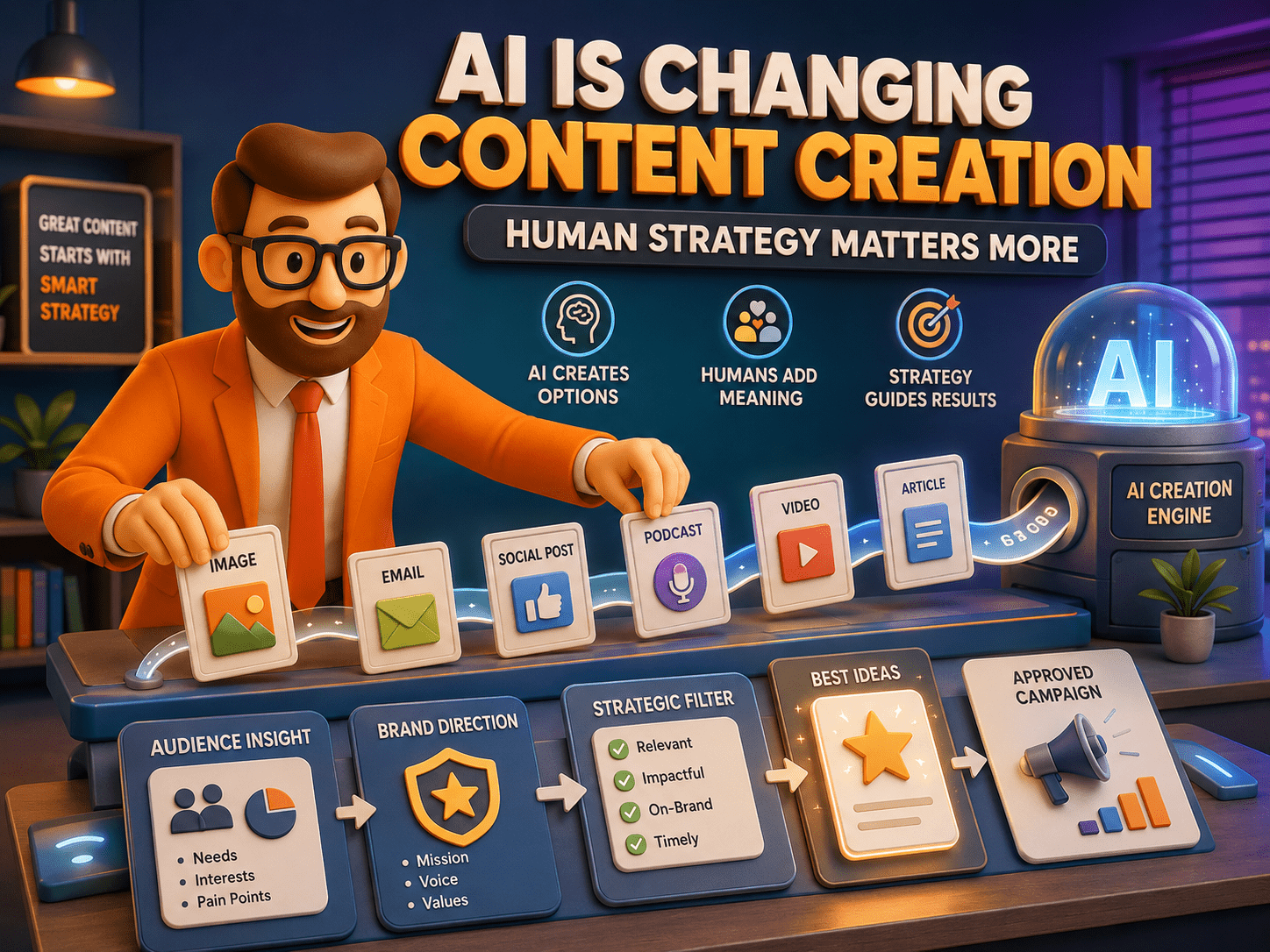

AI tools can help you write faster, plan content more easily, and stay consistent across every platform — but if you’re not careful, they can also make your marketing sound flat, generic, and almost identical to every other business using the same prompts.
The good news is that AI isn’t the reason content sounds robotic. The real issue is when businesses copy and paste whatever the tool generates without shaping it to match their tone, their customers, or the way they naturally communicate. AI shouldn’t be your voice; it should be something that strengthens your voice. When you guide it with clarity and personality, AI becomes an incredibly helpful assistant that helps you move faster while keeping your message grounded, warm, and unmistakably human.
Start With Your Own Point of View Before You Ever Open an AI Tool
AI can only build on what you give it. When the starting point is vague, the output is almost guaranteed to feel generic. The difference between robotic content and natural content begins before the prompt is even written. Spend a moment thinking about the real angle you want to highlight, the problem your audience cares about, or the story you want to tell. Once you’re clear on that, the AI has something meaningful to work with.
In our own work through local digital marketing services, we start with human insight — the customer’s mindset, local patterns, tone guidelines, and brand personality — and then ask AI to support the writing, not replace it. AI becomes most valuable when it expands or organizes ideas you already understand, rather than inventing a message on its own.
Edit Everything With Your Tone, Not AI’s Tone
Even smart tools will occasionally choose phrases that feel stiff or overly formal. This is where your editing becomes the most important step. Read the draft out loud. If something makes you pause, sounds unnatural, or feels like something you’d never say to a real customer, rewrite it. Swap any corporate-sounding language for everyday words. Add small touches — the kinds of phrases you naturally use when speaking to a customer in person.
The goal is not perfection. The goal is personality. Research from Nielsen Norman Group has shown for years that tone plays a major role in how humans process trust online. When your writing sounds like a real person thought about it, paused, reflected, and then shared something helpful, your audience responds with attention instead of scrolling past.
Let AI Handle Structure, but Let Humans Handle the Story
AI is excellent at organizing information. It can quickly create outlines, summary paragraphs, topic clusters, or content calendars. Where it falls short is emotion and lived experience. AI will never know what happened with a customer last week, what inspired you to start your business, or the real challenges people in your city face. That’s the part only a human can add.
A helpful way to think about it is this: AI builds the scaffolding, but you fill in the rooms. If AI gives you a basic explanation of customer service, add an example from someone you helped last month. If it suggests a paragraph about your products, include a moment from your workshop, your kitchen, or your store that captures what makes your approach different. This blend — AI structure with human depth — creates content that feels polished without losing warmth.
Use AI to Generate Options, Not Final Answers
One of the easiest ways to avoid robotic writing is to treat AI like a brainstorming partner. Instead of asking for one version of a headline or caption, ask for several variations. Most of them might not be perfect, but one or two will spark better ideas and move your writing forward. The final version is still yours — AI just makes it faster to reach a strong starting point.
This approach keeps you in control of tone while still using AI’s strength: generating ideas quickly. The key is remembering that the tool doesn’t decide the answer. You do.
Lean on AI for Repurposing — Then Add Your Voice Back In
Repurposing is where AI truly shines. Turning a blog into a social caption, an email intro, or a script outline can take a surprisingly long time when done manually. AI can reduce that work from an hour to a minute. But the trick is to treat the AI output as a draft, not a final product. Add your natural phrasing, adjust the rhythm, and insert small comments or clarifications that bring the content back to life.
This is especially helpful for small businesses trying to stay visible without hiring a full marketing team. AI makes it easy to keep your message consistent across channels without sacrificing personality.
Know When a Human Should Take Over Completely
Even the best AI tool cannot replace genuine human judgment. Some messages simply need your voice. Anything tied to customer emotions, sensitive situations, apologies, brand values, or long-term partnerships is stronger when written directly by you. Moments that require empathy are not moments to outsource.
On the other hand, tasks like grammar cleanup, idea organization, keyword research, first-draft product descriptions, or topic brainstorming are ideal uses for AI. When you match the right tool to the right task, your content becomes smoother, faster to produce, and more sustainable over time.
AI Should Help You Sound More Human, Not Less
When used intentionally, AI becomes a powerful extension of your workflow. It can help you communicate more clearly, publish more consistently, and spend less time staring at a blank page. But the soul of your marketing — the tone, the perspective, the heart behind the message — must always come from a human. That blend of efficiency and personality is what makes AI-assisted marketing stand out while fully preserving your authenticity.
If you’re ready to build a marketing system that uses AI strategically without sacrificing your voice, our team can help. Explore our branding and marketing services to get started.