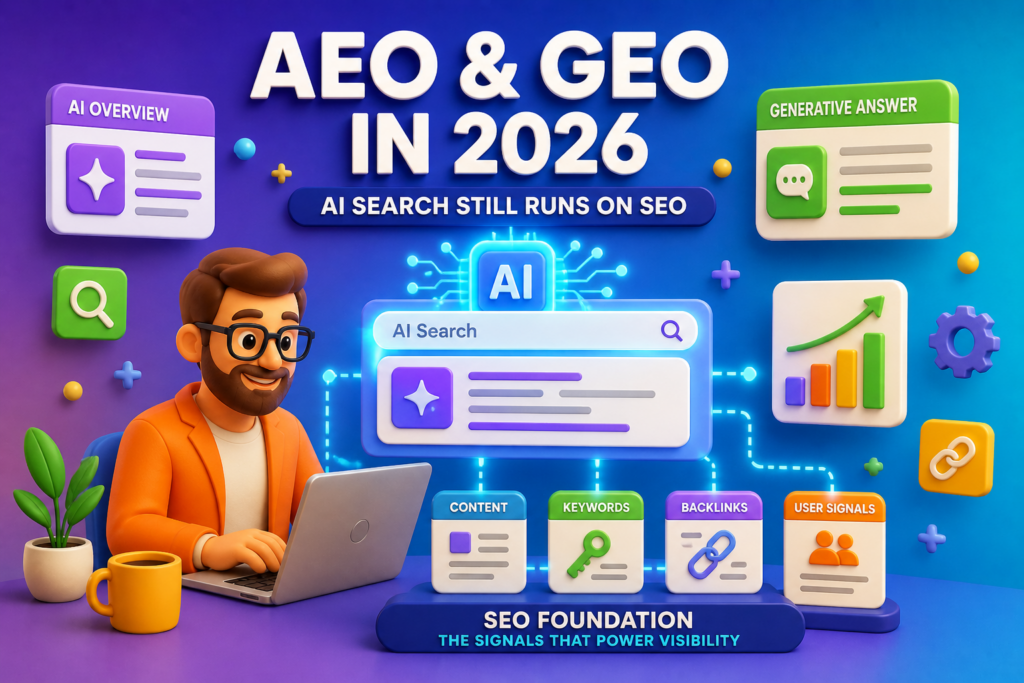
AI search is changing how people discover information online, but it has not replaced SEO. In reality, most AI-driven visibility still depends heavily on traditional SEO foundations.
Terms like AEO (Answer Engine Optimization) and GEO (Generative Engine Optimization) are everywhere right now. They are often framed as entirely new marketing disciplines built specifically for the AI era.
But when you look closely at how AI-powered search systems actually work, the picture becomes much less dramatic.
Most AI-generated answers still rely on the same signals that have shaped search visibility for years: authority, relevance, clarity, structure, usability, and trust.
The difference is that search engines are no longer simply ranking pages.
They are now interpreting, extracting, summarizing, and recombining information directly into AI-generated responses.
That shift matters.
But it does not mean SEO suddenly became obsolete.
If anything, strong SEO matters even more because AI systems still need high-quality content to pull from in the first place.
According to Google’s Search Generative Experience documentation, AI-powered search is designed to help users understand topics faster by synthesizing information from multiple sources. Meanwhile, Semrush’s AI Overviews study found that AI-generated search experiences are expanding rapidly across both informational and commercial search queries.
In other words, AI search is not replacing SEO foundations.
It is layering additional interpretation on top of them.
Key Takeaways
- AEO and GEO are extensions of SEO, not complete replacements for it.
- AI systems still rely heavily on traditional SEO signals like authority, relevance, structure, and trust.
- Clarity and machine-readability matter more than ever as AI systems summarize and extract information directly from content.
- Visibility is shifting from rankings alone to representation inside AI-generated answers.
- Businesses focusing on strong SEO fundamentals are adapting better than those chasing every new AI search trend.
Search Did Not Disappear. It Became More Complex.
One of the biggest misconceptions surrounding AI search is the idea that traditional search behavior has disappeared.
It has not.
People are still searching for answers, comparing products, researching businesses, evaluating services, and trying to make decisions exactly the way they always have.
What changed is how information is delivered.
Instead of simply returning a list of blue links, search engines now interpret intent and generate direct answers using information pulled from multiple sources.
That may include:
- AI-generated summaries
- Featured snippets
- Conversational answers
- Extracted comparisons
- Search overviews built from multiple websites
But none of these systems work without underlying content.
AI systems still need trusted information sources to analyze, interpret, and summarize.
This is why strong SEO remains foundational to visibility.
Content that lacks authority, structure, relevance, or clarity is far less likely to appear in either traditional search rankings or AI-generated responses.
Understanding AEO and GEO Without Overcomplicating It
A lot of confusion in this space comes from making the terminology sound more revolutionary than it actually is.
AEO, or Answer Engine Optimization, focuses on making content easy for search engines and AI systems to extract as direct answers.
This often includes:
- Question-and-answer formatting
- Clear headings
- Concise explanations
- Structured content organization
GEO, or Generative Engine Optimization, expands this idea further.
Instead of optimizing for a single featured answer, GEO focuses on how content can be incorporated into broader AI-generated responses built from multiple sources.
At first glance, this sounds like a completely different strategy.
But when you strip away the terminology, both approaches still rely heavily on strong SEO fundamentals.
Content still needs to be:
- Relevant
- Clear
- Trustworthy
- Well-structured
- Easy to interpret
Those principles are not new.
They have always been central to effective SEO.
Why SEO Is Still Doing Most of the Heavy Lifting
Behind every AI-generated answer, there is still a set of traditional search signals doing most of the foundational work.
Search engines continue evaluating:
- Topical relevance
- Authority
- Internal linking
- User engagement
- Page structure
- Page experience
According to Google’s Helpful Content guidelines, content created primarily to genuinely help users remains central to visibility within modern search systems.
And honestly, that principle still applies inside AI-powered search environments too.
If your content is weak from an SEO standpoint, it likely will not even enter the pool of information AI systems consider using.
This is why investing in strong Huntsville SEO strategies still matters enormously right now.
AEO and GEO do not replace SEO.
They depend on it.
Visibility Is Shifting from Ranking to Representation
One of the more important changes happening right now is how visibility itself is being defined.
For years, search success was tied heavily to ranking position.
The higher your page ranked, the more traffic you typically earned.
That still matters.
But it is no longer the entire picture.
Today, content can influence search experiences even when users never directly visit the source page itself.
Your content may:
- Appear inside AI-generated overviews
- Contribute to conversational answers
- Shape recommendation systems
- Influence generated comparisons and summaries
This creates a new type of visibility.
It is less about simply ranking first and more about how often your information becomes part of the answer itself.
And that representation depends heavily on how understandable your content is.
Clarity Is Becoming a Competitive Advantage
AI systems are designed to process information quickly.
They look for structure, hierarchy, context, readability, and signals that indicate whether content is trustworthy and easy to interpret.
If content is vague, disorganized, or difficult to follow, it becomes harder for AI systems to confidently use it.
On the other hand, content that is well-structured and clearly written becomes much more adaptable.
It is easier to:
- Extract
- Summarize
- Quote
- Reference
- Recombine into AI-generated responses
This does not mean oversimplifying ideas.
It means presenting information in ways that both humans and systems can interpret efficiently.
That includes:
- Clear headings
- Logical flow
- Readable formatting
- Focused sections
- Strong topical organization
In AI-powered search environments, clarity itself is becoming a visibility signal.
The 4 IQs Framework in AI Search
This is also where Carl Holden’s “4 IQs” framework becomes highly relevant in AI-driven search environments.
Analytical IQ powers much of the system itself.
AI relies on authority signals, engagement metrics, contextual analysis, and behavioral data to determine what content is surfaced in response to search queries.
But data alone does not create strong content.
Creative IQ shapes how information is presented.
It influences structure, readability, storytelling, clarity, and tone. It is often the difference between content that feels generic and content that feels intentionally crafted.
Then there is Emotional IQ.
Even in AI-powered search environments, people are still making decisions based on trust, relevance, and clarity.
Content that genuinely understands user concerns tends to perform better because it aligns more naturally with search intent.
Finally, Practical IQ ensures the entire strategy actually works in real-world environments.
It connects usability, SEO, structure, readability, and business goals into something cohesive instead of fragmented.
When all four forms of intelligence work together, content becomes significantly more adaptable across both traditional and AI-driven search experiences.
Authority Signals Are Becoming More Important, Not Less
As AI systems pull information from multiple sources simultaneously, trust signals are becoming even more important.
That includes traditional SEO authority factors like:
- Backlinks
- Domain credibility
- Content depth
- Topical consistency
- Demonstrated expertise
According to Google’s guidance around E-E-A-T (Experience, Expertise, Authoritativeness, and Trustworthiness), demonstrating real expertise and credibility remains central to modern search visibility.
This is also where many businesses struggle with low-quality AI-generated content.
Automated content without genuine insight often sounds technically correct but lacks originality, depth, or authority.
And increasingly, both users and AI systems are getting better at recognizing that difference.
User Experience Still Drives Everything
At the center of all these changes is something that has not actually changed very much at all:
The user.
Search systems continue evolving because user expectations continue evolving.
People want faster answers, clearer explanations, stronger trust signals, and content that genuinely helps them make decisions.
AI-powered search is simply responding to that demand.
This is why businesses often get better long-term results by focusing less on “gaming AI systems” and more on creating genuinely useful content experiences.
If your content answers real questions clearly, explains topics effectively, and provides meaningful insight, it naturally becomes more adaptable across both traditional and AI-driven search environments.
And when that content exists inside a strong, well-structured website supported by thoughtful web design, the overall experience becomes significantly stronger.
Final Thoughts
AEO and GEO may sound like entirely new directions, but they are really extensions of what strong SEO has always focused on.
SEO is still the foundation.
It determines whether content is discoverable, credible, understandable, and authoritative enough to be included in the first place.
The difference now is that content is no longer just being ranked.
It is being interpreted, summarized, recombined, and integrated into broader AI-generated answers.
That shift rewards businesses focusing on clarity, structure, authority, and genuine usefulness.
And honestly, those have always been the fundamentals that mattered most anyway.
If your business is adapting to both traditional SEO and AI-driven visibility, working with a broader Huntsville marketing agency strategy can help ensure your content is not just published, but actually understood and used across evolving search environments.