For years, search engine optimization followed a fairly simple formula. If someone needed information, they opened Google, typed a question, and started clicking links.
That behavior still exists today, and traditional SEO remains one of the most important investments a business can make. But the way people discover information is changing, and it’s changing quickly.
Consumers no longer rely on one platform to answer every question. They move between websites, social media, videos, reviews, and increasingly, AI-powered experiences. The customer journey has become less linear and much more dynamic.
One of the clearest examples of this shift is TikTok.
What started as a platform for short-form entertainment has quietly evolved into a place where millions of people search for products, compare services, find restaurants, plan vacations, and learn new skills.
They’re not just scrolling anymore.
They’re searching.
The question isn’t whether TikTok replaces Google. It doesn’t. The real question is whether businesses can afford to ignore a platform where millions of consumers actively research products and services.
At Zellus Marketing, we see TikTok’s rise as part of a broader evolution in digital discovery. Search, social media, and AI are becoming increasingly interconnected, and businesses that understand those relationships are often better positioned to meet customers where they’re actually looking for information.
Search Is Changing Faster Than Many Businesses Realize
Think about the last time you bought something online.
Did you only use Google?
Probably not.
You may have searched Google, watched a YouTube review, checked social media, read customer comments, and maybe even asked an AI tool for recommendations. Modern consumers gather information from multiple sources because different platforms answer different kinds of questions.
A search engine can provide information quickly. A video can show a product in action. Social media can offer recommendations from real people. Together, they create a much richer decision-making process.
Even Google has acknowledged this shift. As reported by Fortune, Google executives noted that many younger users increasingly turn to TikTok and Instagram for discovery and search activities.
That statement caught the attention of marketers because it validated something many businesses had already begun noticing: people are becoming increasingly comfortable finding information outside traditional search engines.
And why wouldn’t they?
Watching someone demonstrate a product can be more useful than reading a description. Seeing a restaurant’s atmosphere can tell you more than a list of reviews. A thirty-second video can sometimes answer questions faster than several webpages.
Search is becoming more visual, more conversational, and more distributed.
For businesses, that means visibility is becoming broader than rankings alone. It increasingly includes the content, conversations, and experiences that influence decisions before someone ever types a keyword into Google.
Why Are People Using TikTok Like a Search Engine?
At first glance, it seems like an odd question. TikTok wasn’t designed to compete with Google.
Yet millions of people now use it exactly that way.
The reason is surprisingly simple: TikTok often provides context that traditional search results cannot.
Many people use TikTok to search for:
- Product reviews and comparisons
- Restaurant recommendations
- Travel inspiration
- Home improvement ideas
- Beauty and fashion advice
- Technology recommendations
- Local business suggestions
- Tutorials and how-to content
According to TikTok’s research on product discovery, users frequently rely on the platform to discover products and gather information that influences their purchasing decisions.
The appeal makes sense.
If you’re researching a new laptop, would you rather read ten product descriptions or watch someone demonstrate how the computer performs during everyday tasks?
If you’re looking for a restaurant, would you rather browse a list of ratings or see the food, atmosphere, and customer experience in real time?
Video often answers practical questions faster than text because it shows rather than tells.
That doesn’t mean written content is becoming obsolete. It simply means consumers now have more options for how they gather information, and many are choosing formats that feel more personal and easier to understand.
In many ways, TikTok has become a modern version of word-of-mouth marketing. Instead of asking a few friends for recommendations, users can instantly access thousands of experiences, demonstrations, and opinions.
Product Discovery Has Moved Beyond Google
The Journey Doesn’t Always Start With Intent
Traditional SEO often focuses on capturing demand. Someone knows they need something, searches for it, and businesses compete to be found.
But many purchasing decisions now begin much earlier.
A person scrolling through TikTok might discover a kitchen gadget they didn’t know existed. A homeowner could stumble across an organizing solution they had never considered. A traveler may suddenly decide to visit a restaurant because a creator’s video made the experience look memorable.
Discovery increasingly happens before a traditional search query is ever typed.
That changes how businesses should think about content.
Content is no longer only about answering existing demand. It can also create awareness, inspire curiosity, and introduce solutions to problems consumers didn’t realize they had.
Curiosity Often Comes Before Intent
Imagine someone researching home office furniture.
Years ago, they might have started by searching “best standing desk.”
Today, they may first come across a creator showing a beautifully organized workspace. The desk catches their attention. They watch another video, save a few recommendations, and only later search Google for pricing and reviews.
In this example, TikTok didn’t replace search.
It started it.
The businesses that win attention tomorrow may be the ones helping customers discover possibilities today.
This is one of the reasons TikTok has become so interesting from an SEO perspective. It influences what people search for later and can shape purchasing decisions long before someone visits a website.
Google Is Paying Attention to TikTok
Another reason marketers should pay attention to TikTok is that Google itself appears to recognize the value of different content formats.
Through Google Search Central, Google consistently emphasizes the importance of creating helpful content and delivering the best possible information to users regardless of format.
As search experiences evolve, it has become increasingly common to see videos, images, discussions, and social content appear alongside traditional website listings.
TikTok videos now appear in search results for tutorials, product reviews, and trending topics, creating additional opportunities for discovery.
A useful piece of content may begin on TikTok, be shared on social media, surface in Google search results, and eventually drive traffic back to a company’s website.
That’s one of the biggest lessons of modern search.
Content no longer lives in one place.
It moves, gets shared, appears in unexpected places, and contributes to how people perceive a business.
The Relationship Between TikTok and AI Search
Another reason marketers are paying attention to TikTok has less to do with social media and more to do with the future of search itself.
AI-powered search experiences are changing how people discover information. Instead of visiting five or six websites, users can now ask a question and receive summaries, recommendations, and answers in a conversational format.
That raises an interesting question: where does all of that information come from?
The answer is becoming increasingly complex.
Modern search experiences draw from a broad ecosystem of information that includes websites, reviews, articles, videos, social discussions, and public conversations.
That doesn’t mean every TikTok video directly influences an AI-generated answer. It does suggest that a business’s overall digital footprint matters more than ever.
Think about how people research products today.
They may discover a product on TikTok, read reviews on Google, ask an AI tool for recommendations, and then visit the company’s website before making a purchase.
The platforms are different, but the experiences are increasingly connected.
That’s one of the reasons we recently discussed how social media has become a trust signal to people, search, and AI. What happens on one platform can influence discovery, perception, and trust elsewhere.
The future of search appears to be less about individual channels and more about how all of those channels work together.
The Four IQs and What TikTok Reveals About Modern Marketing
At Zellus Marketing, we often look at industry changes through the lens of the Four IQs framework: Data IQ, Search IQ, Social IQ, and Cultural IQ.
TikTok’s rise as a search asset is a perfect example of why all four perspectives matter.
Data IQ: Follow the Signals
The growing use of TikTok for search isn’t simply an interesting trend. It’s a behavioral signal.
Consumers are telling us that they increasingly value information that is visual, practical, and easy to consume.
Businesses that pay attention to these signals can identify opportunities earlier and adapt more effectively to changing expectations.
Ignoring those signals because they don’t fit traditional assumptions about search can be risky.
Search IQ: Search Happens Everywhere
If someone opens TikTok to find a restaurant recommendation, they’re searching.
If they ask an AI assistant for product advice, they’re searching.
If they browse YouTube for tutorials, they’re searching.
The platforms may differ, but the intent is remarkably similar.
Businesses with strong Search IQ understand that visibility increasingly means being useful wherever customers happen to be looking for answers.
Social IQ: Trust Is Built Through Experiences
People have always trusted recommendations from other people.
What has changed is the scale.
Consumers can now instantly access thousands of reviews, demonstrations, and experiences. That information influences purchasing decisions in ways that traditional advertising often cannot.
TikTok’s success as a search platform reflects this desire for practical advice and authentic experiences.
People don’t simply want information anymore. They want context. They want proof. They want to see how something works in the real world.
Cultural IQ: Expectations Continue to Evolve
Every major technological shift changes expectations.
Mobile devices changed how people searched. Social media changed how people discovered information. Short-form video changed how people consume content.
TikTok’s growth as a search platform reflects another shift in expectations.
Consumers increasingly expect information to be immediate, visual, and easy to understand.
Marketing doesn’t stand still because consumer behavior doesn’t stand still.
The businesses that recognize these changes early are often the ones best positioned to adapt.
What Businesses Should Be Doing Right Now
The rise of TikTok as a search platform doesn’t mean businesses need to abandon traditional SEO strategies.
Website optimization still matters. Technical SEO still matters. Creating helpful content still matters.
What is changing is the definition of visibility.
Businesses should begin asking a different set of questions:
- What questions do customers ask before they buy?
- What misconceptions need clarification?
- What demonstrations would help people understand our products or services?
- Where are our customers researching solutions?
- Are we creating content that answers those questions?
Those answers often lead to valuable content opportunities.
A blog article can provide detail and depth. A short video can demonstrate a solution. Social content can reinforce an important idea. Together, they create an ecosystem of information that supports discovery across multiple platforms.
The goal isn’t to replace traditional SEO. The goal is to broaden our understanding of what modern visibility actually looks like.
How Zellus Marketing Views This Shift
At Zellus Marketing, we believe the future belongs to businesses that understand how customer behavior evolves.
TikTok’s emergence as a search asset isn’t simply another social media trend. It’s evidence that discovery is becoming increasingly visual, social, and conversational.
The businesses that succeed in this environment will likely be the ones that focus less on chasing algorithms and more on helping customers.
They’ll answer questions. They’ll provide useful information. They’ll create content that builds trust regardless of where customers happen to be searching.
Most importantly, they’ll recognize that search, social media, content, and AI are becoming parts of the same ecosystem rather than separate marketing channels.
Final Thoughts
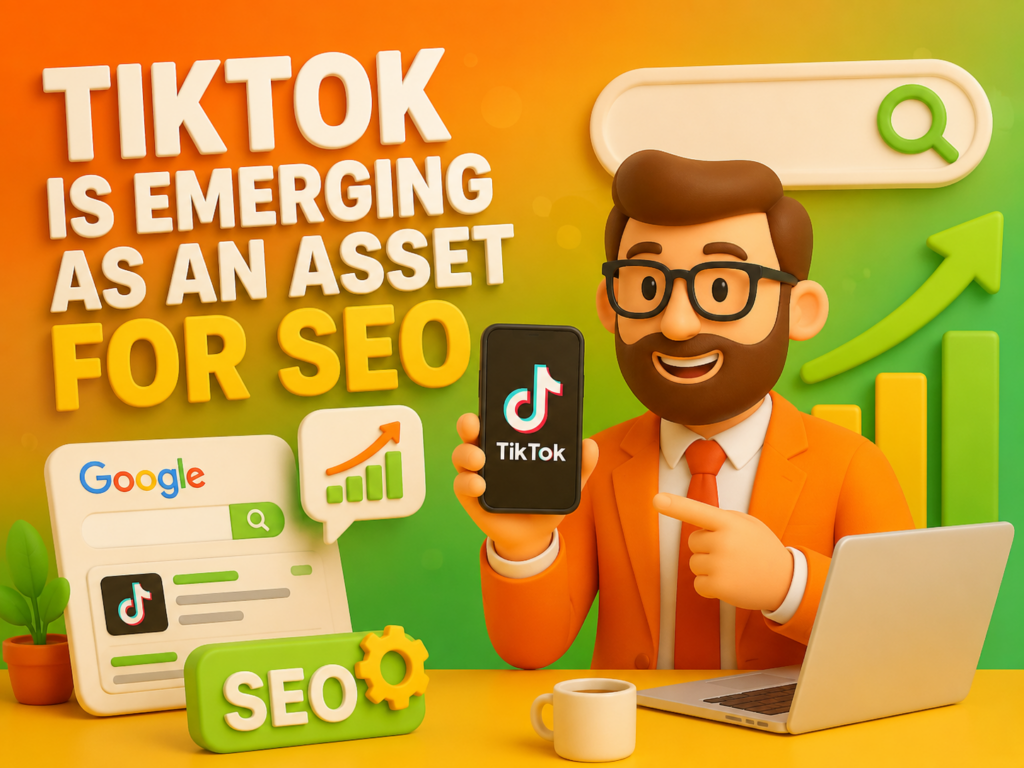
TikTok is emerging as an asset for SEO not because it replaces Google, but because it reflects a much larger shift in how people discover information.
Consumers now move fluidly between platforms, looking for recommendations, demonstrations, and answers wherever they believe they can find the most useful information.
Search is becoming more visual, more conversational, and more distributed than ever before.
For businesses, that creates both a challenge and an opportunity.
The challenge is letting go of outdated assumptions about where discovery happens. The opportunity is creating content that reaches customers earlier in their decision-making journey and builds trust across multiple channels.
The platforms will continue to evolve. Consumer expectations will continue to change. The businesses that thrive will be the ones willing to evolve alongside them.
If your business is building a stronger digital presence across social platforms, SEO, branding, and AI-driven visibility, taking a broader Huntsville marketing agency approach can help ensure all those systems reinforce each other instead of operating separately.