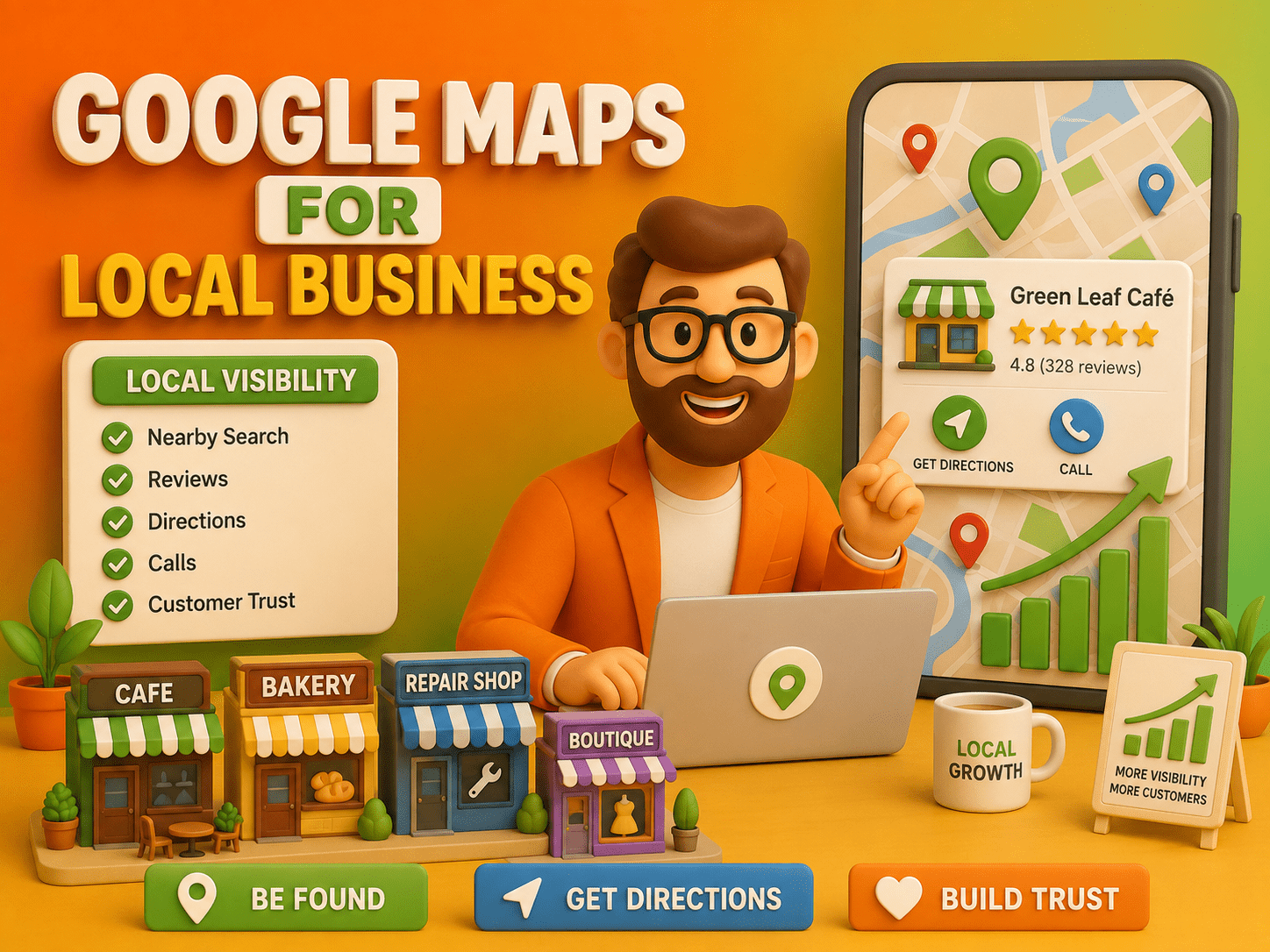
Your next customer probably won’t meet you first.
They’ll meet your Google Business Profile.
That simple reality has changed local marketing more than many business owners realize.
Think about the last time you needed a service quickly.
Maybe it was a plumber after a burst pipe.
Perhaps it was a dentist after an unexpected toothache.
Or maybe you were looking for a nearby restaurant while traveling.
Regardless of the situation, there’s a good chance you reached for your phone before asking anyone for a recommendation.
You opened Google.
You typed a simple search.
Within seconds, Google Maps presented several businesses that could solve your problem.
At that moment, something important happened.
You started making decisions before visiting a single website.
- Which business has the strongest reviews?
- Which one looks professional?
- Which company seems active?
- Which business would you feel comfortable calling?
Those questions rarely take more than a few moments to answer.
Even so, they often determine which business earns the opportunity to speak with a potential customer.
For many local businesses, the first impression no longer happens on a website.
Instead, it happens on Google Maps.
This behavior isn’t limited to one industry.
Homeowners compare contractors.
Families research pediatricians.
Business owners evaluate accountants.
Travelers browse restaurants and coffee shops.
Meanwhile, shoppers look for local retailers.
The industries may be different.
However, the decision-making process is remarkably similar.
People aren’t simply searching for a nearby business.
They’re searching for confidence.
Reality Check
Before contacting a business, many customers quietly ask themselves:
- Can I trust this company?
- Does this business look established?
- Have other customers had positive experiences?
- Does it appear professional?
- Would I feel comfortable spending my money here?
Interestingly, many people answer those questions before they ever visit the company’s website.
The First Impression Has Quietly Moved
For years, businesses invested heavily in creating great websites.
That investment still matters.
A professional website builds credibility, explains your services, and helps visitors learn more about your business.
Today, however, the customer journey often starts somewhere else.
Google Maps has quietly become the place where many first impressions are formed.
That’s because customer expectations have changed.
People want answers quickly.
They also want enough information to feel comfortable making a decision.
Fortunately, Google Maps makes it easy to compare several businesses at once.
Within a few minutes, customers can review ratings, browse photos, read comments, confirm business hours, and locate directions.
As a result, many people narrow their choices before opening a single website.
Customers rarely compare websites first.
More often, they compare confidence.
That distinction is more important than it might seem.
Some businesses believe they’re competing primarily on price.
Others focus on offering more services than their competitors.
Both approaches have value.
Nevertheless, neither one matters until a customer believes the business is trustworthy.
That’s why local visibility and customer confidence work together.
One attracts attention.
The other earns consideration.
Google Maps Is More Than a Navigation Tool
Most people think of Google Maps as an app for finding directions.
That’s certainly one of its most recognizable features.
For local businesses, however, it serves another purpose.
It helps customers decide who deserves their trust.
Consider everything someone can learn in less than two minutes.
| What Customers See | What They Often Think |
|---|---|
| Recent reviews | “People still recommend this business.” |
| Owner responses | “The company cares about its customers.” |
| Current photos | “This business looks professional.” |
| Updated hours | “The information is reliable.” |
| Complete business details | “This feels like a legitimate company.” |
None of these details guarantees outstanding service.
Together, however, they reduce uncertainty.
That matters because uncertainty is one of the biggest obstacles to any buying decision.
The easier it becomes for someone to trust your business, the easier it becomes for them to choose it.
Marketing Insight
Customers rarely choose a business simply because it’s nearby. More often, they choose the business that feels like the safest and most trustworthy decision.
The Customer Journey Didn’t Disappear—It Evolved
Some people assume Google Maps has replaced the traditional customer journey.
That’s not quite true.
Instead, the journey has evolved.
Years ago, a potential customer might have searched Google, clicked on a website, explored several pages, and then decided whether to make contact.
Today, that same person often begins by comparing businesses directly within Google Maps.
Only after narrowing the options do they visit a website, request directions, or make a phone call.
As a result, businesses have less time to earn someone’s confidence than ever before.
Google Maps doesn’t replace your website.
It often determines whether someone visits your website in the first place.
That subtle shift has changed the way local businesses should think about their online presence.
Rather than viewing Google Maps as a simple directory listing, it’s more helpful to see it as the front entrance to your digital business.
First impressions have always mattered.
Now they simply happen sooner.
Small Details Shape Big Decisions
Customers rarely announce why they chose one business over another.
In many cases, they couldn’t fully explain it even if they tried.
Instead, dozens of small observations combine to create an overall impression.
For example, someone might notice that one business has recent customer photos while another has images from several years ago.
Likewise, a company that responds politely to reviews often appears more approachable than one that remains silent.
Even something as simple as updated holiday hours can reinforce the idea that a business is attentive and well managed.
None of these details guarantees excellent service.
Together, however, they help reduce uncertainty.
And when uncertainty decreases, confidence tends to grow.
Quick Exercise
Open Google Maps and search for your own business.
Now imagine you’ve never heard of your company before.
Ask yourself these questions:
- Does the business immediately appear trustworthy?
- Are the photos current and professional?
- Would the reviews make you feel comfortable?
- Is every detail accurate?
- Would you confidently choose this business over the one listed beside it?
The answers often reveal opportunities that are easy to overlook when you’re viewing your business from the inside.
Why Customer Psychology Matters More Than Ever
Every purchase involves some level of uncertainty.
Customers wonder whether they’re making the right choice.
Naturally, they look for signals that reduce that uncertainty.
That’s why reviews matter.
That’s why photos matter.
That’s why complete business information matters.
Collectively, these signals help answer an important question:
“Can I trust this business?”
Once that question has been answered positively, everything else becomes easier.
Customers feel more comfortable visiting your website.
They’re more willing to make a phone call.
Additionally, they’re more likely to request a quote or schedule an appointment.
People don’t want more information.
They want enough confidence to take the next step.
Local Marketing Is Becoming a Trust Economy
Many conversations about local SEO focus on rankings.
Rankings certainly matter.
Without visibility, potential customers may never discover your business.
Even so, visibility alone isn’t enough.
Once someone finds your business, trust becomes the deciding factor.
That’s why successful local marketing combines two equally important goals.
| Goal | Why It Matters |
|---|---|
| Increase visibility | Help more people discover your business. |
| Build trust | Help more people choose your business. |
Businesses that focus on only one of these goals often struggle.
On the other hand, businesses that improve both tend to create sustainable long-term growth.
Marketing Insight
The strongest local marketing strategies don’t just generate more searches. They generate more confidence, stronger relationships, and better customer experiences from the very first interaction.
That idea becomes even more important as artificial intelligence, customer expectations, and local search continue to evolve.
Trust Begins Long Before the First Conversation
Many business owners assume the sales process begins when the phone rings.
In reality, it often begins much earlier.
Long before a customer calls your office, submits a contact form, or walks through your front door, they’ve already been gathering information.
They’ve compared businesses.
They’ve read reviews.
They’ve looked at photos.
They’ve checked business hours.
Perhaps they’ve even visited your website.
By the time they finally contact you, one important decision has usually been made.
They already believe your business might be the right choice.
The phone call doesn’t create trust.
More often, it confirms the trust you’ve already earned.
That’s one of the biggest reasons Google Maps has become so valuable for local businesses.
Instead of acting as a simple directory, it has become one of the first places where confidence is built—or lost.
Quick Tip
Pretend you’re searching for your business for the very first time. Ask yourself, “Would I confidently choose this company based only on what I see here?” That simple exercise often reveals opportunities you might otherwise overlook.
Customers Look for Evidence, Not Marketing Claims
Every business says it delivers excellent service.
Customers expect that.
What they really want is evidence.
That’s why Google Maps has become such an influential decision-making tool.
Rather than relying only on advertising, customers can see how other people describe their experiences.
For many buyers, that’s far more persuasive than any headline on a homepage.
Psychologists often refer to this as social proof.
Simply put, people feel more comfortable making a decision after seeing that others have already made the same decision successfully.
Google Maps makes that evidence available in just a few clicks.
| Trust Signal | What Customers Often Think |
|---|---|
| Recent reviews | “People are still choosing this business.” |
| High-quality photos | “This company takes pride in its work.” |
| Owner responses | “Someone genuinely cares about customers.” |
| Accurate business details | “This information appears reliable.” |
| Consistent positive feedback | “I can probably expect a good experience too.” |
Interestingly, none of these trust signals talks about price.
Instead, each one helps reduce uncertainty.
Once uncertainty begins to disappear, confidence naturally grows.
Customers don’t buy confidence.
They buy after they feel confident.
Reviews Tell a Story Your Website Can’t
Imagine you’re searching for a family dentist.
Two practices appear near the top of Google Maps.
Both have attractive websites.
Both offer similar services.
Even so, one practice has hundreds of recent reviews describing friendly staff, gentle care, and excellent communication.
The other has only a handful of reviews from several years ago.
Which one feels like the safer choice?
Most people reach the same conclusion almost immediately.
That’s because reviews answer questions your marketing copy simply can’t answer.
- Were appointments handled professionally?
- Did the staff communicate clearly?
- Were customers treated with respect?
- Would previous clients return?
Future customers aren’t reading reviews to learn about someone else’s experience.
Instead, they’re trying to predict their own.
Marketing Insight
Every positive review becomes part of your reputation. More importantly, it helps answer questions that future customers haven’t asked yet.
Photos Reduce Uncertainty Faster Than Words
A picture doesn’t replace great service.
However, it often creates a stronger first impression than a paragraph of marketing copy.
Think about the last time you searched for a restaurant while traveling.
There’s a good chance you looked through the photos before reading the menu.
The same behavior applies to many local businesses.
Customers want to see your office.
They want to see completed projects.
They want to see your team.
Ultimately, they want reassurance that your business is real, active, and professional.
Fortunately, authenticity usually matters more than perfection.
Fresh, genuine photos often create more trust than heavily edited promotional images.
Customers aren’t looking for a perfect business.
They’re looking for a trustworthy one.
Consistency Is One of the Most Underrated Marketing Strategies
Whenever Google updates its search systems, businesses naturally begin looking for shortcuts.
While that’s understandable, shortcuts rarely create lasting results.
Instead, the businesses that consistently perform well usually share a different habit.
They stay consistent.
- They keep their business information current.
- They encourage honest customer feedback.
- They upload fresh photos regularly.
- They respond respectfully to reviews.
- They continually improve the customer experience.
None of those activities is particularly exciting.
Together, however, they create something far more valuable than a temporary ranking boost.
They build a reputation.
Reality Check
Algorithms will continue changing. Customer expectations will continue evolving. Trust, however, remains one of the few competitive advantages that never goes out of style.
Understanding Google Maps Through the Four IQs
At Zellus Marketing, we often talk about the Four IQs.
That’s because long-term marketing success rarely comes from mastering a single tactic.
Instead, sustainable growth happens when businesses understand how technology, customer behavior, and strategy work together.
| IQ | How It Strengthens Local Marketing |
|---|---|
| Data IQ | Understand how customers discover and interact with your business. |
| Search IQ | Recognize that visibility matters only when it leads to trust. |
| Social IQ | Use reviews and customer engagement to strengthen your reputation. |
| Cultural IQ | Adapt as customer expectations and technology continue to evolve. |
Businesses that embrace these four perspectives don’t simply appear in more searches.
More importantly, they become easier to trust.
Getting discovered is important.
Getting chosen is what truly drives growth.
AI Isn’t Replacing Local Search—It’s Changing Customer Expectations
Artificial intelligence has become one of the biggest topics in marketing.
Naturally, that has raised plenty of questions for local business owners.
Will AI replace Google Search?
Will customers stop using Google Maps?
Should businesses completely rethink their local marketing strategies?
Those are reasonable questions.
However, they often overlook a much bigger shift.
AI isn’t changing the fact that people need local businesses.
Homeowners still need plumbers.
Families still need dentists.
Business owners still need accountants.
Travelers still need restaurants.
Instead, AI is changing how people discover, compare, and evaluate those businesses.
Artificial intelligence isn’t replacing trust.
It’s making trustworthy businesses even easier to recognize.
As search platforms become smarter, they rely even more on accurate information, customer feedback, business credibility, and consistent online signals.
That’s one reason Google Business Profile continues to play such an important role in local marketing.
The better your online presence reflects your real business, the easier it becomes for both customers and search technology to understand what you offer.
Marketing Insight
Businesses that prepare for AI don’t chase every new tool. Instead, they focus on becoming the most accurate, trustworthy, and helpful option in their local market.
Four Common Mistakes That Quietly Cost Local Businesses Customers
Many businesses assume they’re losing customers because competitors spend more on advertising.
Sometimes that’s true.
More often, though, small details influence customer decisions long before advertising becomes a factor.
Fortunately, most of these issues can be corrected.
1. Treating Google Business Profile Like a Set-It-and-Forget-It Tool
Claiming your profile is only the first step.
As your business grows, your online information should grow with it.
Updated services, current business hours, fresh photos, and accurate contact information all contribute to a stronger customer experience.
2. Ignoring Customer Reviews
Reviews influence far more than your overall rating.
They shape how future customers perceive your business.
Likewise, thoughtful responses demonstrate professionalism, accountability, and a genuine commitment to customer service.
3. Leaving Old Photos Online
Your business changes over time.
Your online presence should reflect those changes.
Current photos help customers visualize the experience they’ll have when they visit your business or work with your team.
4. Thinking Your Website Does All the Work
Your website remains one of your most valuable marketing assets.
Even so, many buying decisions begin before anyone clicks through to it.
That’s why your website and Google Business Profile should complement one another rather than operate independently.
Reality Check
Your strongest competitor isn’t always the business with the biggest marketing budget. More often, it’s the business that makes customers feel the most confident.
A Five-Minute Google Maps Audit
If you’re wondering where to begin, start with a simple review of your own business listing.
Set aside five minutes and work through the following checklist.
- Is every piece of contact information accurate?
- Are your business hours current, including holidays?
- Have you uploaded new photos within the last few months?
- Are you responding professionally to recent reviews?
- Does your primary business category still reflect what you do?
- Would a first-time customer immediately understand your services?
- Does your listing inspire confidence?
Although each improvement may seem small, they work together to create a stronger first impression.
Over time, those small improvements can have a meaningful impact on customer confidence.
Small improvements create stronger first impressions.
Stronger first impressions create more opportunities.
Questions Every Business Owner Should Be Asking
Rather than focusing only on rankings, consider asking questions that reflect the customer’s perspective.
- Would I trust this business if I’d never heard of it before?
- Does my Google Business Profile accurately represent my company today?
- Are customers telling the story I want future customers to hear?
- Do my photos reflect the quality of my work?
- What impression do I create before someone ever speaks with my team?
- Am I making it easy for customers to choose me?
These questions shift your attention away from algorithms alone.
Instead, they focus on the customer experience.
Ultimately, that’s where sustainable marketing success begins.
Did You Know?
Google reports that people increasingly use Search and Maps together to discover nearby businesses, compare options, and decide where to go next. That means your Google Business Profile often influences a buying decision before a customer ever visits your website.
Success Comes From Building Trust, Not Chasing Algorithms
Search technology will continue evolving.
Artificial intelligence will continue improving.
Customer expectations will continue changing.
Nevertheless, one principle has remained remarkably consistent.
Businesses that earn trust are easier to choose.
That’s why the most successful local marketing strategies aren’t built around shortcuts.
Instead, they’re built around serving customers well, maintaining an accurate online presence, and making every interaction count.
Algorithms help people find businesses.
Trust helps people choose them.
The Bigger Opportunity Isn’t Google Maps—It’s Customer Confidence
At first glance, this article might seem to be about Google Maps.
In reality, it’s about something much more important.
It’s about how people decide who to trust.
Technology will continue to evolve.
Search engines will continue to improve.
Artificial intelligence will introduce new ways for customers to discover businesses.
Even so, one principle has remained remarkably consistent.
Before people spend their money, they want to feel confident they’re making the right decision.
Whether someone is hiring a contractor, choosing a law firm, scheduling a dental appointment, or selecting a restaurant for dinner, that decision is driven by confidence as much as convenience.
Google Maps simply gives customers the information they need to make that decision faster.
People don’t search for Google Maps.
They search for confidence.
Businesses that understand this shift stop thinking only about rankings.
Instead, they focus on creating an experience that builds trust before the first conversation ever happens.
Key Takeaway
Every review, every updated photo, every accurate business detail, and every customer interaction contributes to one outcome: making it easier for someone to confidently choose your business.
Five Key Lessons Every Local Business Can Apply
- Your Google Business Profile is often your first impression—not your website.
- Trust signals such as reviews, photos, and accurate information influence buying decisions every day.
- Consistency builds credibility far more effectively than short-term marketing tricks.
- Artificial intelligence rewards businesses with reliable, well-maintained digital information.
- Visibility attracts attention, but trust earns customers.
Although these ideas sound straightforward, they create a meaningful competitive advantage when applied consistently.
That’s because every improvement makes the next customer a little more comfortable choosing your business.
Helping Businesses Become Easier to Find—and Easier to Trust
At Zellus Marketing, we believe the future of local marketing isn’t about chasing every algorithm update.
Instead, it’s about understanding how technology and human behavior work together.
That’s why we help businesses strengthen both their online visibility and their customer experience.
When those two elements work together, marketing becomes far more sustainable.
If you’d like to build a stronger local marketing strategy that keeps pace with today’s search landscape, learn more about our Huntsville marketing services.
You can also continue exploring how trust influences modern search by reading our article, Social Media Is a Trust Signal to People, Search, and AI.
Frequently Asked Questions
Does Google Maps help local SEO?
Yes. Google Maps and Google Business Profile are important parts of local SEO because they help customers discover nearby businesses while also giving Google accurate information about your company.
How often should I update my Google Business Profile?
Review your profile regularly. Whenever your hours, services, phone number, address, or photos change, update your listing promptly. In addition, respond to new customer reviews whenever possible.
Are customer reviews really that important?
Absolutely. Reviews provide social proof, answer questions future customers may have, and help reduce uncertainty before someone contacts your business.
Can small businesses compete with larger companies on Google Maps?
Yes. Many customers prioritize trust, relevance, proximity, and recent customer experiences over company size. As a result, smaller businesses with strong local reputations often compete very successfully.