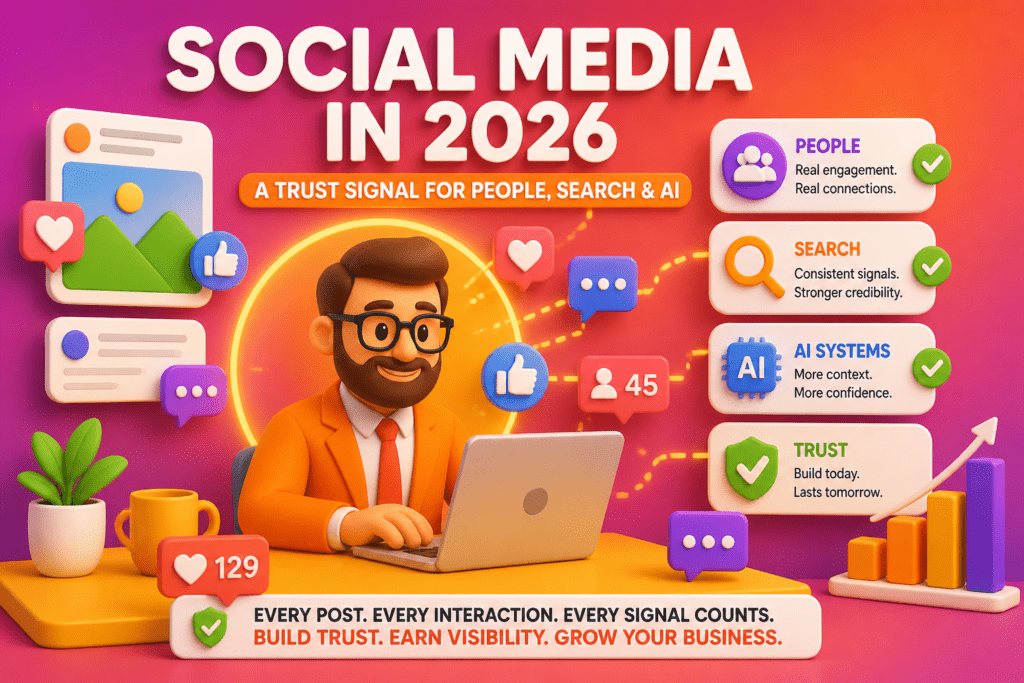
Social media is no longer just a marketing channel. In 2026, it has become one of the strongest trust signals influencing how people, search engines, and AI systems evaluate businesses online.
For years, businesses treated social media primarily as a visibility tool. The focus was usually on growing followers, increasing engagement, posting consistently, and staying active across platforms.
That role still matters, but it no longer reflects the full picture.
Today, social media quietly influences credibility across almost every stage of the customer journey. People may discover your business through Google search, but many immediately check Instagram, LinkedIn, Facebook, TikTok, or YouTube before deciding whether the company actually feels legitimate.
And increasingly, AI systems are doing something surprisingly similar.
According to Sprout Social’s social media research, consumers increasingly expect brands to maintain active, responsive, and authentic social presences. Meanwhile, Google’s AI-powered search experiences continue pushing search toward broader contextual understanding instead of isolated keyword evaluation.
That means your social presence is no longer operating separately from your website, SEO strategy, branding, or AI visibility.
It is now part of the same trust ecosystem.
Key Takeaways
- Social media now functions as a trust signal for users, search engines, and AI systems.
- Consistency matters more than viral moments when building long-term credibility online.
- Search engines increasingly evaluate businesses holistically across websites, social platforms, and external references.
- AI systems analyze patterns across multiple digital touchpoints to evaluate authority, legitimacy, and relevance.
- Strong branding, clarity, and consistency across channels now directly influence trust.
Social Media Has Shifted from Visibility to Validation
For years, businesses measured social media success mostly through visibility metrics like follower counts, likes, shares, reach, and engagement spikes.
Those metrics still matter to some extent, but they no longer tell the full story.
In 2026, social media plays a much deeper role in how businesses are perceived online. It acts as a validation layer.
When users discover a company for the first time, they rarely rely on a single source anymore. Someone may find your business through search, then immediately open Instagram or LinkedIn before making any decision at all.
And honestly, most people do this almost automatically now.
They are not necessarily looking for perfection. They are looking for confirmation.
Does the business appear active? Does the branding feel aligned? Does the company seem current or abandoned? Do real people engage with the content? Does the messaging match what the website claims?
Those signals shape trust long before a purchase decision is made.
Research from HubSpot’s State of Marketing report continues to show that consumers increasingly expect brands to maintain cohesive digital presences across multiple channels.
That expectation has expanded far beyond marketing itself. People now interpret digital consistency as a signal of operational legitimacy.
And when social profiles look neglected, disconnected, or inconsistent, hesitation appears almost immediately.
Trust Is Built Through Patterns, Not Individual Posts
One of the biggest misconceptions businesses still have about social media is the belief that trust comes from isolated viral moments.
In reality, trust is usually built through repeated patterns over time.
A single viral post may generate attention, but long-term credibility is created through consistency.
People notice whether businesses show up regularly. They notice whether branding stays recognizable. They notice whether communication feels stable and human instead of random and reactive.
That consistency creates predictability, and predictability creates trust.
This is where many businesses unintentionally create friction.
They post aggressively for a few weeks, disappear for months, then suddenly become active again when sales slow down. Others constantly shift tone, branding, messaging, and positioning without any clear consistency.
That instability becomes visible very quickly.
Not just to users, but increasingly to search systems and AI systems too.
According to Edelman’s Trust Barometer research, consistency and authenticity remain major drivers of trust in digital environments.
And honestly, this aligns closely with how modern search systems evaluate authority as well.
Search engines and AI systems are increasingly trying to identify signals that indicate whether businesses appear reliable over time, not simply optimized for short bursts of attention.
Search Engines Are Evaluating Businesses More Holistically
There has always been debate around whether social media directly impacts search rankings.
But focusing only on “direct ranking factors” misses the bigger picture.
Modern search engines increasingly evaluate businesses holistically.
Google and other search systems are no longer looking only at isolated keywords or individual pages. They are trying to understand broader signals around legitimacy, consistency, expertise, and authority.
Social media contributes heavily to that larger credibility ecosystem.
An active social presence reinforces legitimacy. Consistent branding reinforces trust. Real engagement reinforces authenticity. Brand mentions reinforce recognition.
These may not function as simplistic ranking boosts, but they absolutely contribute to the broader trust profile search systems evaluate.
This is one reason strong Huntsville SEO strategies increasingly overlap with branding, social media, and reputation management instead of existing as isolated technical disciplines.
Because visibility online is no longer coming from one source alone.
Everything reinforces everything else.
AI Systems Are Evaluating Behavioral Consistency Too
AI systems approach credibility somewhat differently than traditional search engines, but the underlying principle is surprisingly similar.
They evaluate patterns.
When AI systems generate summaries, recommendations, or references, they do not rely on a single source of information. They analyze broader consistency across multiple digital touchpoints.
That includes website content, structured business information, reviews, third-party mentions, authority references, and social media activity.
Social platforms provide valuable contextual signals because they reveal ongoing business behavior.
They show whether a company appears active, engaged, current, responsive, and consistently represented over time.
Even when those signals are not directly visible inside AI-generated answers themselves, they still influence how confidently systems interpret and reference a business.
This is part of a much larger shift happening across digital visibility overall.
Search systems are becoming increasingly contextual, and contextual systems naturally evaluate consistency across environments instead of isolated optimization tactics.
The Difference Between Activity and Credibility
Another important shift businesses are starting to realize is that activity alone does not automatically create credibility.
Posting constantly is not the same thing as building trust.
In fact, overposting without strategic clarity can sometimes weaken credibility instead of strengthening it.
Users are becoming increasingly sensitive to content that feels manufactured, overly promotional, or disconnected from actual expertise.
That is one reason businesses relying entirely on AI-generated social content without human oversight often struggle to build meaningful engagement.
The content may technically follow best practices, but it often lacks emotional specificity, original perspective, and genuine understanding of audience concerns.
And people notice that difference surprisingly quickly.
According to Nielsen Norman Group research, users consistently respond more positively to communication that feels authentic, understandable, and clearly human-centered.
That does not mean businesses should avoid AI tools.
It means AI works best when supporting strategy instead of replacing human perspective entirely.
The 4 IQs Framework Applies Directly to Social Media
This is another area where Carl Holden’s “4 IQs” framework becomes especially practical.
Analytical IQ helps businesses understand what actually resonates with audiences. Analytics reveal engagement patterns, audience retention, click behavior, response trends, and performance insights that help refine strategy over time.
But data alone does not create emotional connection.
Creative IQ shapes how the business is visually and verbally presented. It influences storytelling, identity, design consistency, content style, and overall memorability. It is often what separates distinctive brands from interchangeable ones online.
Then there is Emotional IQ.
This may actually be one of the most important elements in social trust-building today.
Social media remains fundamentally human. People respond to businesses that feel relatable, emotionally aware, and genuinely aligned with audience concerns.
Finally, Practical IQ keeps everything sustainable.
It ensures social systems remain organized, scalable, maintainable, and aligned with broader business goals instead of becoming chaotic bursts of inconsistent activity.
When all four forms of intelligence work together, social media becomes much more than a content distribution channel.
It becomes a long-term trust system.
Inconsistency Creates More Friction Than Silence
Many businesses assume inactivity is the biggest social media problem.
But honestly, inconsistency often creates even more friction than occasional silence.
A profile that posts aggressively for short periods and then disappears creates uncertainty. It signals instability, even when unintentionally.
On the other hand, businesses maintaining steady, reliable communication patterns often feel significantly more trustworthy, even if they post less frequently overall.
This matters because users are not simply evaluating individual pieces of content anymore.
They are evaluating behavioral patterns.
And increasingly, AI systems are evaluating those same patterns too.
Consistency itself is becoming part of digital credibility.
Social Media and Website Experience Are Becoming Tightly Connected
Another major shift happening right now is how closely social media and website experience are connected.
Users rarely move through a single channel in a perfectly linear way anymore.
Someone may discover a business through search, browse the website, check Instagram, revisit later through LinkedIn, and then return again before making a final decision.
If those experiences feel disconnected, hesitation increases.
If they feel aligned, confidence builds significantly faster.
This alignment comes down to consistency in messaging, visual identity, positioning, tone, and overall user experience.
When supported by thoughtful web design, those transitions between platforms feel seamless instead of fragmented.
And seamless experiences build trust faster.
This is one reason businesses increasingly need integrated marketing systems instead of isolated digital channels operating independently.
Businesses Are Quietly Being Evaluated All the Time
One of the biggest changes happening in digital marketing right now is that businesses are being evaluated continuously instead of during isolated moments.
Years ago, businesses could focus heavily on campaigns, launches, or promotional pushes.
Today, users are constantly forming impressions based on the cumulative experience of interacting with a brand across multiple environments.
That includes social media activity, website quality, search visibility, reviews, brand mentions, and overall communication consistency.
Every interaction contributes to a broader trust profile.
And increasingly, AI systems are interpreting those patterns at scale.
This is why businesses focusing only on short-term visibility tactics often struggle to build durable authority online.
Trust today is cumulative.
It is built through repeated alignment across channels over time.
What Businesses Should Actually Focus On
With changing algorithms, constant platform updates, and endless social media advice online, businesses often feel pressure to reinvent their strategy constantly.
But the businesses performing best right now usually focus on something much simpler.
They prioritize consistency, clarity, reliable communication, strong branding, and long-term trust-building.
They do not try to dominate every platform simultaneously.
They focus on maintaining credible, recognizable presences where their audience actually pays attention.
And they treat social media as part of a larger reputation system rather than just another content distribution channel.
This approach may look less flashy in the short term, but over time it creates significantly stronger authority.
Final Thoughts
Social media is no longer separate from search.
And it is no longer separate from AI visibility either.
It influences how people perceive businesses, how search systems evaluate credibility, and how AI systems interpret consistency across digital environments.
The businesses adapting best to this shift are not necessarily posting more content.
They are building more intentional systems.
They understand that trust is no longer created through isolated campaigns or occasional viral moments alone.
It is built through consistent signals repeated across multiple touchpoints over time.
And honestly, that is probably where digital marketing is heading overall.
Visibility still matters.
But credibility is increasingly becoming the real differentiator.
If your business is building a stronger digital presence across social platforms, SEO, branding, and AI-driven visibility, working with a broader Huntsville marketing agency strategy can help ensure all those systems reinforce each other instead of operating separately.