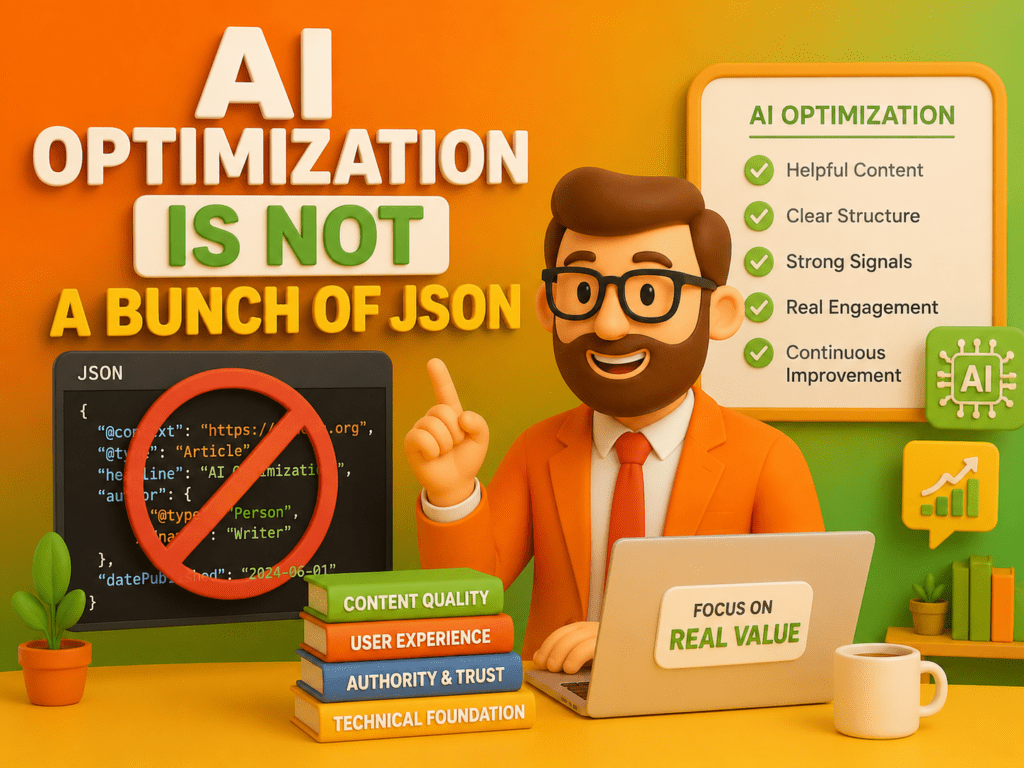
Every new technology creates a race to find the shortcut.
When social media became a marketing channel, businesses searched for the perfect posting formula. When search engine optimization became mainstream, countless articles promised hidden ranking factors that would supposedly move websites to the top of Google overnight. Artificial intelligence is no different.
Today, one of the most common claims surrounding AI search is surprisingly simple:
“Just add more JSON or schema markup, and AI will understand your website.”
It’s an attractive idea because it turns a complicated challenge into a manageable checklist. If AI visibility depends on adding a little structured data, then businesses have a clear action item. Developers know what to implement. Marketers know what to request. Everyone feels like progress is being made.
Unfortunately, technology rarely rewards simple answers to complicated questions.
Structured data is valuable. Schema markup has been an important part of technical SEO for years. Yet the growing conversation around AI optimization has begun stretching those facts into conclusions that current evidence doesn’t fully support.
That’s an important distinction.
There’s a significant difference between saying that structured data helps search engines interpret information and claiming that JSON is the key to AI visibility. One statement reflects established best practices. The other assumes we already understand how AI systems evaluate and surface information.
Marketing Insight
Whenever a new technology emerges, the industry often mistakes correlation for causation. A tactic that contributes to success can quickly become described as the reason for success, even when the broader picture is far more complex.
Why This Conversation Matters
The debate isn’t really about JSON.
It’s about how businesses make decisions when technology changes.
Marketing budgets are limited. Development time is limited. Every hour spent chasing an unproven tactic is an hour that isn’t being invested elsewhere. That’s why it’s important to separate what we know from what we think we know.
This doesn’t mean businesses should ignore structured data. Quite the opposite. Schema markup continues to serve an important role in helping search engines understand webpages and qualify for enhanced search features.
However, the conversation becomes much more interesting when we ask a different question.
What if AI optimization isn’t about finding one winning tactic?
What if it’s about understanding how multiple signals work together?
That question changes everything.
Instead of searching for a technical shortcut, it encourages businesses to examine the broader digital ecosystem that influences how information is discovered, evaluated, and ultimately trusted by both search technologies and the people using them.
Before we can answer that question, though, we need to understand why JSON became the center of the AI optimization conversation in the first place.
Why JSON Became the Center of the Conversation
The popularity of JSON-LD and schema markup didn’t happen because marketers invented the idea out of thin air. It developed from years of legitimate technical SEO best practices.
Search engines have long encouraged website owners to provide structured data that helps computers interpret information more accurately. Instead of forcing search engines to guess what a page contains, schema markup clearly identifies products, services, organizations, authors, reviews, events, FAQs, and many other types of content.
Google has openly supported structured data for years because it improves how search engines organize information and can enable enhanced search features, including rich results.
Given that history, the industry’s next assumption seemed perfectly reasonable.
If structured data helps search engines understand content, wouldn’t it also help artificial intelligence understand that same content?
On the surface, the logic appears sound.
AI systems process enormous amounts of information. Structured information is generally easier for software to interpret than unstructured information. Consequently, many marketers concluded that adding more schema would naturally improve visibility in AI-powered search experiences.
The problem wasn’t the reasoning.
The problem was treating a logical hypothesis as if it were already an established fact.
Marketing Insight
Digital marketing often advances through educated hypotheses. The challenge is knowing when an idea has been validated through evidence—and when it’s still a theory waiting to be tested.
When Assumptions Meet Real Testing
As AI-powered search became more common, researchers began looking for measurable answers instead of relying on speculation.
One of the most discussed analyses was highlighted by SEO Roundtable. The study examined nearly 1,900 webpages to explore whether schema markup had a meaningful impact on how often pages were cited in AI-generated search experiences.
The findings challenged one of the industry’s most popular assumptions.
The researchers found no clear correlation showing that pages with schema markup consistently received more AI citations than comparable pages without it.
That’s an important result—but it’s equally important not to overinterpret it.
The study didn’t conclude that schema markup lacks value.
Nor did it suggest businesses should remove structured data from their websites.
Instead, the findings point toward a more balanced conclusion.
Schema appears to be an important technical practice.
Current evidence simply doesn’t show that it is the deciding factor behind AI visibility.
That’s a meaningful distinction because it shifts the conversation away from finding a single ranking signal and toward understanding how AI systems may evaluate many different types of information together.
Reality Check
- Structured data continues to be recommended by Google.
- Schema remains an important part of technical SEO.
- Current public research has not demonstrated that JSON alone improves AI citations.
- AI optimization remains an evolving discipline rather than a fixed formula.
What the Research Really Tells Us
The biggest takeaway isn’t that schema works or doesn’t work.
The real lesson is that AI search appears to be more sophisticated than many early discussions suggested.
Modern AI systems aren’t simply looking for well-structured code. They appear to evaluate content within a much broader context that includes information quality, authority, relevance, consistency, and countless other signals that continue to evolve.
That doesn’t make structured data less valuable.
It simply places it in its proper role: an important component of technical SEO rather than a standalone AI optimization strategy.
Once that distinction becomes clear, the conversation changes.
The question is no longer whether businesses should use JSON. They should.
The more useful question becomes this:
If structured data is only one piece of the puzzle, what does the complete picture actually look like?
Answering that question requires looking beyond individual tactics and thinking about how AI evaluates an organization’s entire digital presence rather than a single block of code.
A Better Question Leads to Better Strategy
Once we stop asking whether JSON is the answer, a much more useful question emerges.
What actually influences how AI discovers, understands, and recommends information?
At the moment, nobody outside the companies building these AI systems can answer that question with complete certainty. Google’s AI Overviews, ChatGPT, Perplexity, Claude, and other large language models all rely on different technologies, different training methods, and different ways of retrieving information.
However, one pattern is becoming increasingly clear.
These systems don’t appear to rely on a single technical signal. Instead, they evaluate information through many interconnected signals that collectively help determine credibility, usefulness, and relevance.
That shouldn’t be surprising.
Even traditional search engines have never ranked websites using only one factor. Technical SEO, content quality, topical expertise, user experience, page performance, authority, and countless other signals have always worked together.
Artificial intelligence appears to be moving in the same direction—only with an even greater emphasis on understanding context rather than simply matching keywords.
Marketing Insight
Businesses often ask how to optimize for AI. A more valuable question is how to become the most reliable source of information in your industry. The second question naturally leads to better long-term decisions.
Looking Beyond Individual Tactics
That’s why focusing exclusively on schema markup can become limiting.
Structured data remains an important technical best practice, but it’s only one component of a much larger digital ecosystem.
Think about how people evaluate a business.
They rarely make a decision based on one signal alone. Instead, they consider the company’s website, reviews, expertise, reputation, published content, recommendations, and overall consistency.
Although AI systems don’t think like humans, they also appear to benefit from multiple signals working together rather than depending on one isolated piece of information.
That’s why businesses preparing for AI search shouldn’t ask whether they have enough schema.
They should ask whether their entire digital presence consistently demonstrates expertise.
| Instead of Asking… | Ask… |
|---|---|
| Do we have enough JSON? | Is our information clear and well organized? |
| What’s the newest AI trick? | How do we become the best resource in our industry? |
| Will AI read our pages? | Are we publishing content worth referencing? |
| Can one tactic solve AI optimization? | How can every part of our digital presence reinforce credibility? |
Notice how each question shifts the conversation away from individual tactics and toward long-term strategy.
That’s the mindset we believe businesses should adopt as AI search continues to evolve. Rather than chasing isolated tactics, organizations benefit from developing a comprehensive digital strategy that aligns technical SEO, content, brand authority, and user experience. Working with an experienced Huntsville marketing agency can help businesses build that long-term foundation while adapting to emerging AI search technologies.
The Four IQs: A More Complete Framework
At Zellus Marketing, this broader perspective has shaped how we think about AI optimization.
Rather than viewing AI visibility as a technical checklist, we evaluate it through what we call the Four IQs: Data IQ, Search IQ, Social IQ, and Cultural IQ.
Each IQ represents a different dimension of a business’s digital presence. Individually, they’re valuable. Together, they create a stronger foundation for helping both people and AI systems understand who you are, what you do, and why your information deserves attention.
The Four IQs don’t claim to reveal a hidden AI ranking formula. Instead, they provide a practical framework for thinking about digital visibility in a world where technology is becoming increasingly sophisticated.
In the next section, we’ll explore each of the Four IQs and explain why they work together to create a more resilient strategy than relying on any single optimization technique.
The Four IQs in Practice
The Four IQs aren’t intended to replace SEO best practices or introduce another optimization checklist. Instead, they provide a broader way of thinking about digital visibility in an environment where AI systems are becoming increasingly capable of evaluating context rather than isolated signals.
Rather than asking whether one tactic will improve AI visibility, the framework asks whether every aspect of a business’s online presence reinforces the same message: this organization is knowledgeable, trustworthy, and consistently helpful.
Data IQ: Can Technology Understand Your Business?
Data IQ focuses on technical clarity.
This is where structured data, JSON-LD, metadata, internal linking, crawlability, page performance, and information architecture all play an important role. These technical elements help search engines and AI systems interpret what your business does and how your content is organized.
However, organization isn’t the same as authority. A perfectly structured website with thin or outdated content still gives AI very little reason to recommend it.
Think of Data IQ as making your expertise easy to understand—not creating expertise where none exists.
Search IQ: Are You Solving Real Problems?
Search IQ shifts the focus from code to content.
Businesses often ask what keywords they should target. A better question is whether they’re consistently answering the questions their customers are already asking.
Helpful articles, detailed service pages, original insights, topical authority, and a logical content structure all contribute to a stronger search presence. Those same qualities also make content more useful for AI systems that summarize and recommend information.
AI doesn’t just need information.
It needs information worth referencing.
Social IQ: Does the Rest of the Internet Agree?
A website never exists in isolation.
Reviews, social media conversations, local listings, industry publications, podcasts, interviews, videos, and community discussions all contribute to a business’s broader digital footprint.
Although we don’t know exactly how every AI platform weighs these signals, it’s reasonable to expect that consistent recognition across multiple trusted sources strengthens overall credibility.
That’s why Social IQ isn’t measured by follower counts. It’s measured by whether your expertise is being reinforced across the wider web.
Cultural IQ: Are You Keeping Up With How People Search?
Technology evolves because people evolve.
Customer expectations change. Search habits change. New platforms emerge. Questions that mattered two years ago may no longer be the questions people ask today.
Cultural IQ encourages businesses to stay connected to those shifts. Instead of reacting only after algorithms change, organizations can create content that reflects how real people think, speak, and make decisions.
That makes a business more resilient regardless of which AI platform or search technology becomes dominant in the future.
Key Takeaway
Data IQ, Search IQ, Social IQ, and Cultural IQ are strongest when they work together. Technical excellence makes information easier to understand. Helpful content demonstrates expertise. Consistent recognition builds credibility. Understanding people keeps your business relevant. None of these dimensions replaces the others.
Looking Ahead
Will AI optimization continue to evolve? Almost certainly.
Will today’s best practices change as AI systems become more capable? History suggests they will.
That’s exactly why businesses should avoid building their strategy around a single tactic. The organizations that adapt most successfully won’t be the ones chasing every new trend. They’ll be the ones building a strong digital foundation that can adapt as technology changes.
In the final section, we’ll bring these ideas together and discuss what they mean for businesses preparing for the future of AI-powered search.
What Businesses Should Do Next
If there’s one lesson from the current AI optimization conversation, it’s this: don’t confuse a useful tactic with a complete strategy.
Schema markup deserves to remain part of every modern website. It improves technical clarity, supports structured search features, and helps search engines interpret content more effectively. Those benefits haven’t changed.
What has changed is the environment in which businesses compete for visibility. AI-powered search experiences are becoming more sophisticated, drawing on multiple signals to evaluate information instead of relying on a single technical implementation.
That means organizations should think beyond individual optimizations and focus on building a digital presence that consistently demonstrates expertise, authority, and relevance across every customer touchpoint.
Businesses that invest in technical excellence, publish genuinely helpful content, build a strong reputation, and adapt to changing customer behavior are positioning themselves for long-term success—regardless of how AI search evolves.
Preparing Your Business for AI Search
- Maintain accurate schema markup and structured data.
- Create original, experience-driven content that answers real customer questions.
- Strengthen topical authority by publishing consistently within your areas of expertise.
- Keep business information accurate across your website, local listings, and social platforms.
- Earn reviews, mentions, and citations from reputable sources.
- Continue improving page speed, mobile usability, accessibility, and technical SEO.
- Monitor emerging AI search developments instead of chasing every new trend.
Our Perspective at Zellus Marketing
AI optimization is still in its early stages. While the industry continues to learn how AI platforms retrieve, interpret, and recommend information, one thing has become increasingly clear: businesses shouldn’t base their strategy on assumptions or isolated tactics.
At Zellus Marketing, we believe the strongest long-term strategies are built on a combination of technical excellence, meaningful content, strong digital reputation, and a deep understanding of how people search and make decisions. As a digital marketing agency, we’ve developed the Four IQ framework to help businesses think beyond individual ranking factors and instead build a digital presence that remains resilient as technology continues to evolve.
Whether AI search changes gradually or rapidly over the coming years, businesses that consistently provide accurate information, demonstrate expertise, and create genuine value for their audiences will be in the strongest position to adapt.
The future of AI optimization won’t belong to the businesses with the most JSON.
It will belong to the businesses that become the most trusted source of information in their industry.
Frequently Asked Questions
Should I still use schema markup?
Yes. Schema markup remains an important technical SEO best practice and helps search engines better understand your content. The current discussion is about avoiding the assumption that schema alone determines AI visibility.
Can JSON improve AI search rankings?
There is currently no public evidence showing that JSON-LD by itself improves AI-generated citations or rankings. It should be viewed as one component of a broader digital strategy rather than a standalone solution.
What is the Four IQ framework?
The Four IQ framework is Zellus Marketing’s strategic approach to AI optimization. It encourages businesses to strengthen four interconnected areas of digital presence: Data IQ, Search IQ, Social IQ, and Cultural IQ.
Is AI optimization different from traditional SEO?
Traditional SEO remains an essential foundation. AI optimization expands on that foundation by considering how AI systems discover, interpret, and synthesize information from multiple sources while emphasizing context, authority, and user value.
Final Thoughts
The conversation around AI optimization will continue to evolve as search technologies mature and new research emerges. Some of today’s assumptions will be confirmed, while others will inevitably be challenged.
Rather than searching for shortcuts, businesses should focus on the fundamentals that have consistently delivered value: making information easy to understand, publishing content that genuinely helps people, earning credibility over time, and adapting to changing customer expectations.
Schema markup remains an important part of that foundation—but it isn’t the entire foundation. AI optimization is bigger than a block of JSON. It’s about creating a digital presence that both people and intelligent systems can recognize as authoritative, reliable, and worth recommending.
Technology will continue to evolve. Credibility, expertise, and usefulness will continue to matter.